
THE HUMAN
OPERATING SYSTEM
"The storm is not the enemy. The enemy is the belief that you must control the storm."
Tony Greenberg
Founder & CEO, ImpactSoul | Co-Founder, RampRate
December 2025
Initialize
"The illiterate of the 21st century will not be those who cannot read and write, but those who cannot learn, unlearn, and relearn."
"The danger is that if we invest too much in developing AI and too little in developing human consciousness, the very sophisticated artificial intelligence of computers might only serve to empower the natural stupidity of humans."
"The old world is falling apart. The new world is being born. In between, there is a great deal of confusion and suffering. But this is also a time of tremendous opportunity—to let go of what no longer serves us and to create something beautiful."
Boiling the Human Revisited
At a Humanity+ conference at Harvard in 2010, I shared the stage with Ray Kurzweil to celebrate human potential and ingenuity. Yet even in that heady age of tech optimism—on the eve of Arab Spring when social media was undermining rather than enabling authoritarianism—I wasn't there to blindly cheerlead progress.
Instead, I warned about the drive to exploit, to add fine print, to enshittify every product for an additional dollar—and how the process could be so slow and imperceptible that we would fail to notice it like a frog slowly being boiled alive. Few listened. The congregation was drunk on possibility.
Two years later, in 2012, I wrote about the Human Operating System—arguing that "artificial intelligence is no match for natural stupidity" and that we needed technology built to fit humans "like a glove instead of a cast." The thesis has only become more urgent.
Today we both can claim the mantle of prophecy. In the last five years, we've made as big a leap as any since splitting the atom. Yet the value of this change to humanity is just as ambiguous as the nuclear age. With superhuman intelligence at our fingertips, we haven't become supermen. We've become shallower, more anxious, and less capable.
The World Waking Up
The good news is that the pace of change has jolted us into awareness. Maybe the frog was boiled too fast and can still jump out of the pot.
"If I said an alien species is coming in five years—maybe they will be nice, maybe they will cure cancer, but they will take our power to control the world from us—people would be terrified. This is the situation we're in. But instead of coming from outer space, the threat is coming from California."
Tristan Harris, former Design Ethicist at Google, describes "human downgrading"—the systematic erosion of human capacity through technologies optimized for engagement rather than flourishing. Aza Raskin, who invented the infinite scroll, now speaks with deep regret. They founded the Center for Humane Technology, warning that social media was humanity's first contact with AI—and that humanity lost.
Tristan and Aza are acquaintances of mine, and I'm gratified to see their power and direction become more relevant every day. They've reached hundreds of millions with their message. The world is finally listening.
"Computer algorithms optimized for profit are splintering our society by reducing attention spans, accelerating addiction, polarization, apathy, and mistrust in science."
An Algorithm for Human Scale Agency
Yet I did not write this to add to the chorus of doom. Fear is not just a poor foundation for flourishing—it's a surrender to the very forces you think you're fighting. The attention economy profits from your anxiety. Don't let them.
I offer a different path: agency at human scale. In a world of systems designed to break you down, you can stand tall and reclaim your self-determination.
Ancient Wisdom and Modern Science Converge
Many wisdom traditions that survived millennia converge on similar core practices: moderation, community, presence, contentment. The Stoics knew this two thousand years ago. The Buddhists knew it five hundred years before that. This convergence reflects invariant features of human flourishing.
Fifty-five years ago, Alvin Toffler warned of "Overchoice." Thirty-four years later, Barry Schwartz proved him right. In The Paradox of Choice, he identified Maximizers (who exhaustively search for optimal) and Satisficers (who stop at "good enough"). The finding was counterintuitive: satisficers are happier.
THE SIX PRINCIPLES
For those who feel they can't get their head above water, here's an imperfect start. Six principles. Not commandments. Invitations.
1. Choose satisficing over maximizing.
Set clear criteria for "good enough." Once met, stop searching. The maximizer's pursuit is a trap algorithms exploit. The satisficer's contentment is a fortress they cannot breach.
2. Embrace voluntary simplification.
Reduce complexity by choice before circumstances compel it. This is not deprivation but liberation. Own fewer things. Maintain fewer accounts. Cultivate fewer but deeper relationships.
3. Build at human scale.
Robin Dunbar discovered humans can maintain approximately 150 stable relationships. Invest in these Dunbar-scale communities—your 15-50 deep bonds, your 5 inner circle. These sustain you when large systems fail.
4. Redefine abundance.
True abundance is not accumulation; it is alignment. When resources flow toward your conscious intentions, scarcity dissolves. Shift from "Do I have enough?" to "Am I contributing enough?"
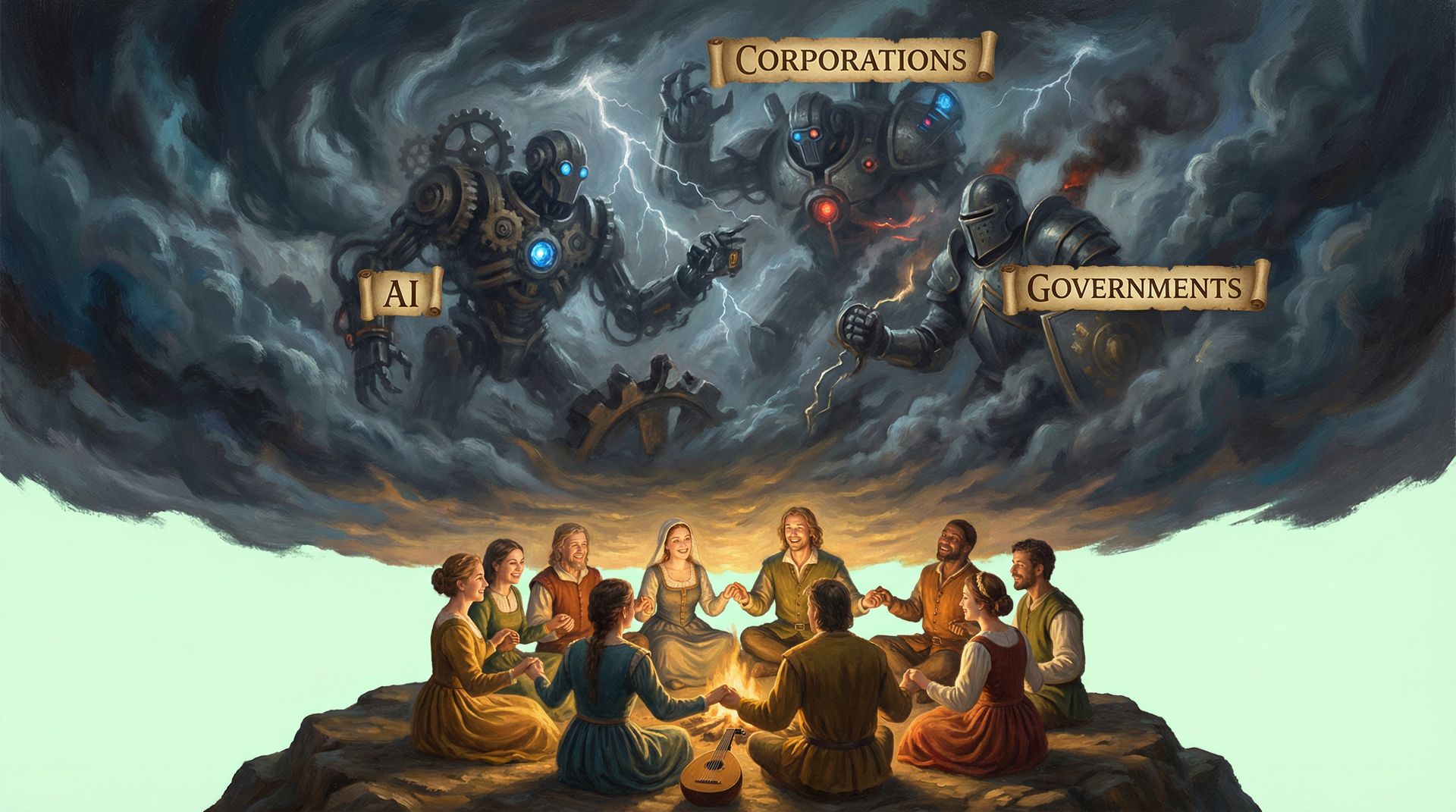
5. Let the titans compete.
Large corporations, governments, and AI systems will compete for dominance. You don't need to participate. Turn inward. Build community. Create meaning. Redirect attention to what you can actually affect.
6. Love more, need less.
The ultimate hedge against AI dominance and civilizational stress is genuine human love, presence, and connection. These require no external energy, scale poorly (which is their strength), and constitute the irreducible core of flourishing.
For Every Rule, There Are Exceptions
This framework assumes baseline security. If you're in survival mode, meet basic needs first. This addresses a different pathology: suffering that persists despite material abundance.
Satisficing is not settling. The satisficer chooses sufficiency from clarity. The settler accepts inadequacy from exhaustion.
Know when to maximize. Don't satisfice on safety, health, or ethics. Maximize your child's blossoming. Maximize your closest relationships. Satisfice on secondary decisions that drain bandwidth without adding meaning.
Specific Steps to Take Today
- On your information diet: Limit news to one focused session daily. Eliminate notifications except direct messages from people you know.
- On your finances: Maintain 6-12 months liquidity. Avoid debt that creates dependency. Invest in resilience—skills, relationships, community.
- On your relationships: Quality over quantity. Depth over breadth. Difficult conversations now, boundary-setting now, repair work now.
- On your mind: Invest in practices that restore your nervous system: meditation, nature, exercise, connection, sleep. These are not luxuries. They are infrastructure.
Phase 2: Rebuilding the Systems
Just like pre-flight instructions that tell you to put on your oxygen mask before assisting others, find your own serenity first. Then join me in designing systems-breakers to help us find ourselves again.
When I build ImpactSoul, I'm enabling reconciliation between making a living and doing good—while rebuilding human-scale connections in self-governing decentralized communities.
"If a company or country is in decline, you can try voice or you can try exit."
Balaji Srinivasan—crypto-philosopher and architect of The Network State—offers the maximizer's complement to this framework. He's building a startup society prototype near Singapore, arguing technology should "reduce the barrier to exit" by giving people alternatives to broken systems.
But we converge on a crucial point: a startup society must be "about community culture first, and technological innovation second." Technology serves values, not the reverse. This inversion drives ImpactSoul—we tokenize assets not because blockchain is fashionable, but because aligning economic incentives with human flourishing requires new infrastructure.
Balaji builds the new airplane. I'm asking you to secure your oxygen mask first. First find your center. Then build.
Coda
The storm is coming—or perhaps it is already here. You cannot control the storm. But you can become the kind of person who navigates storms with grace. You can build the kind of community that weathers storms together. And once you do, you can start systemic change to make the journey easier for others.
It begins with you. It begins now.

About the Author
Tony Greenberg is a systems thinker who has spent over 25 years at the intersection of technology, consciousness, and capital allocation. As Founder & CEO of ImpactSoul, building a new impact economy through tokenization of iconic real-world assets; and Co-Founder of RampRate, a Certified B Corporation advising Fortune 500 companies, he operates at the leading edge of technological and economic change.
In 2010, he presented "Boiling the Human" at the Humanity+ Summit at Harvard, sharing the stage with Ray Kurzweil. In 2012, he articulated the concept of the Human Operating System—technology that fits humans "like a glove instead of a cast" and combines individual powers rather than using them to score points against each other.
The Puzzle Pieces
Each person I've met, each conversation I've had, each advisor who signed up for my bag of cookies—they are all part of the development of my ideals. And for that, I appreciate each one of them.
These ideals are belief systems: thoughts attached to feelings. This construct was brought out by Arnold Patent in his seminal book You Can Have It All—do buy and read it. I'm also shaped by Ram Dass, after studying with him for much time in Maui. And I'm profoundly influenced by my partner and glorious artist Clarisse Abelarde, whose work is shown here as a constant inspiration to my creativity and my love for humankind. These teachings didn't emerge from isolation or pure intellect. They crystallized through thousands of books and even more conversations—late-night debates, boardroom strategy sessions, chance encounters that shifted my perspective by a single degree, which over time became a completely different direction.

Every advisor who joined this journey, every skeptic who challenged my assumptions, every visionary who saw what I couldn't yet articulate—they each added a piece to the puzzle. The Human OS framework you see here is not mine alone. It's the distillation of collective wisdom, the simplification of profound complexity that only emerges when diverse minds collide and collaborate.
This is how we absorb AI and AGI into our lives. This is how we find our place in the sun. Not through individual genius, but through the patient accumulation of insight, the willingness to learn and unlearn, and the humility to recognize that the formula for navigating this new era was always going to be a collaborative effort.
To everyone who contributed—whether you know it or not—thank you. You are the operating system behind the Operating System.
Share Your Thoughts on the Manifesto
Anonymous comments welcome—no login required
18 Comments
Test Commenter 3
about 2 months ago
I'm skeptical about the transformation claims. Seems too idealistic.
Test Commenter 1
about 2 months ago
This manifesto is transformative. The Conscious Satisficer concept resonates deeply.
Test Commenter 3
about 2 months ago
I'm skeptical about the transformation claims. Seems too idealistic.
Test Commenter 1
about 2 months ago
This manifesto is transformative. The Conscious Satisficer concept resonates deeply.
Test Commenter 3
about 2 months ago
I'm skeptical about the transformation claims. Seems too idealistic.
Test Commenter 1
about 2 months ago
This manifesto is transformative. The Conscious Satisficer concept resonates deeply.
Test Commenter 1
about 2 months ago
This manifesto is transformative. The Conscious Satisficer concept resonates deeply.
Test Commenter 3
about 2 months ago
I'm skeptical about the transformation claims. Seems too idealistic.
Test Commenter 1
about 2 months ago
This manifesto is transformative. The Conscious Satisficer concept resonates deeply.
Test Commenter 3
about 2 months ago
I'm skeptical about the transformation claims. Seems too idealistic.
Test Commenter 3
about 2 months ago
I'm skeptical about the transformation claims. Seems too idealistic.
Test Commenter 1
about 2 months ago
This manifesto is transformative. The Conscious Satisficer concept resonates deeply.
Test Commenter 3
about 2 months ago
I'm skeptical about the transformation claims. Seems too idealistic.
Test Commenter 1
about 2 months ago
This manifesto is transformative. The Conscious Satisficer concept resonates deeply.
Test Commenter 3
about 2 months ago
I'm skeptical about the transformation claims. Seems too idealistic.
Test Commenter 1
about 2 months ago
This manifesto is transformative. The Conscious Satisficer concept resonates deeply.
Test Commenter 1
about 2 months ago
This manifesto is transformative. The Conscious Satisficer concept resonates deeply.
Test Commenter 3
about 2 months ago
I'm skeptical about the transformation claims. Seems too idealistic.